
COURSES
CONVENIENT SCHEDULING
Classes at Foundation Baptist College are available in two convenient scheduling formats:
SEMESTER CLASSES
Most of our courses are offered on a weekly basis over the course of a college semester. Some are offered in the morning while others are offered as evening courses.
BLOCK CLASSES
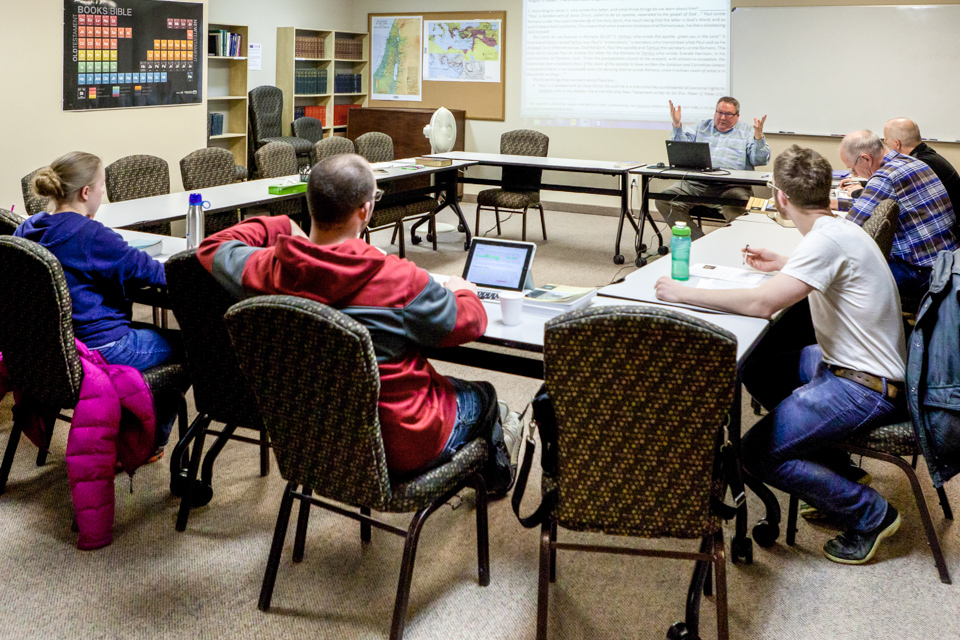
Each semester we offer several courses on a block schedule. All classroom sessions for our block classes take place during a single week—with sessions in the evenings (Monday to Friday) and several sessions on Saturday.
- Systematic and Biblical Theology
- Biblical Exposition
- Church History
- Practical Theology
- Languages and Exegesis
- General Education
- Graduate Classes
THE 100 The Great Questions of Christianity (Introduction to Doctrine) (3 hours)
An introduction to core Christian beliefs by exploring Scripture’s answers to key theological questions. Students learn to think theologically and communicate evangelical doctrine clearly.
THE 110 Biblical Theology (The Big Picture Story of Scripture) (3 hours)
A survey of Scripture’s unified storyline from creation to new creation, highlighting the covenants and how the Old and New Testaments center on Christ. Students learn to explain and apply biblical theology to ministry.
THE 231 Bible Doctrines 1 (God, Scripture, Angels, Man, Sin) (3 hours)
A study of God, the Trinity, Scripture, creation, angels, humanity and sin, grounded in Scripture. Students learn to articulate these doctrines and apply them to issues of dignity, evil, and spiritual conflict.
THE 241 Bible Doctrines 2 (Salvation, People of God, Last things) (3 hours)
A study of the doctrine of salvation, the people of God, and last things. Students learn to define key soteriological terms, the offices and purposes of the church, and the various frameworks interpreters use for thinking about the end of all things.
THE 351 One Book, Two Testaments (Dispensationalism, Intertextuality) (3 hours)
A study of the unity of Scripture and how the New Testament fulfills the Old. Students trace intertextual connections and evaluate major interpretive systems such as dispensationalism.
BIB 100 Old Testament Survey (3 hours)
A survey of the Old Testament as the foundation of God’s redemptive plan. Students learn the historical flow, major themes, and how the OT points to Christ.
BIB 150 New Testament Survey (3 hours)
A survey of the New Testament as the climax of God’s redemptive plan. Students learn the message, structure, and theological contributions of each section.
BIB 221 Pentateuch (3 hours)
An overview of Genesis–Deuteronomy with attention to theology, structure, and difficult passages. Students learn to relate OT law and themes to Christ and Christian living.
BIB 225 Historical Books and Wisdom (3 hours)
A survey of Joshua–Esther in their historical and theological context. Students learn to trace God’s work in Israel’s story and apply its principles today. This course also surveys job, Psalms, Proverbs, Ecclesiastes, and Song of Solomon as poetic, theological, and practical books.
BIB 251 Gospels (3 hours)
A study of the four Gospels focusing on the person and work of Jesus. Students learn each Gospel’s distinct contribution and how to teach Christ’s message today.
BIB 261 Acts (2 hours)
A study of Acts as the record of the Spirit’s work in the early church. Students learn to trace the church’s expansion and apply its mission to contemporary ministry.
BIB 331 Major Prophets (3 hours)
A study of Isaiah, Jeremiah, Lamentations, and Ezekiel in their historical setting and prophetic message. Students learn to interpret key themes fulfilled in Christ.
BIB 341 Minor Prophets (3 hours)
A study of the twelve Minor Prophets in their historical and covenant context. Students learn to trace themes of judgment, mercy, and messianic hope for today’s ministry.
BIB 371 Epistles (3 hours)
A study of the New Testament letters as pastoral and theological instruction for the church. Students learn to interpret key doctrines and apply them to Christian community.
BIB 381 Daniel and Revelation (2 hours)
A study of Daniel and Revelation as apocalyptic books revealing God’s sovereignty and Christ’s triumph. Students learn to interpret their symbols and apply their hope to Christian living.
BIB 431 Exegesis of Psalms (elective) (3 hours)
An exegetical study of Psalms as a major theological center of the Old Testament. Students learn to interpret and analyze poetry, exegete intertextual relationships, and apply the Psalms to present life. Classroom instruction will include but not require Hebrew language exegesis.
BIB 441 Exegesis of Ecclesiastes (elective) ( 3 hours)
An exegetical study of Ecclesiastes noting divergent approaches to the book. Students learn to interpret and analyze poetry, handle challenging passages, and proclaim Ecclesiastes to a contemporary audience. Classroom instruction will include but not require Hebrew language exegesis.
BIB 451 Exegesis of Matthew (elective) ( 3 hours)
An exegetical study of Matthew with attention to historical interpretation, theological implications, and close exegetical analysis. Classroom instruction will include Greek language exegesis.
BIB 461 Exegesis of Romans (elective) ( 3 hours)
An exegetical study of Romans with attention to historical interpretation, theological implications, and close exegetical analysis. Classroom instruction will include Greek language exegesis.
HIS 211 Church History I (Pentecost to Renaissance) (3 hours)
A survey of the church from the apostles to the Renaissance, tracing doctrine, leadership, and mission. Students learn how early developments shape the church today.
HIS 213 Church History II (Reformation to Present) (3 hours)
A survey of major people, movements, and ideas in church history through the modern era. Students gain appreciation for God’s work in history and confidence for present ministry.
HIS 361 Canadian Church History (2 hours)
A survey of Christianity in Canada from its beginnings to Confederation. Students learn to interpret Canada’s theological heritage and apply it to current ministry.
PRT 100 Sanctification and Christian Growth (3 hours)
A study of how believers grow in Christ through God’s plan, prayer, and spiritual disciplines. Students learn to address wrong views of sanctification and guide others toward maturity.
PRT 210 Theology of Prayer (2 hours)
A study of the biblical theology of prayer,examining prayer’s nature, purpose, and place in the Christian life. Students explore prayer throughout Scripture, the relationship between prayer and the character of God, the role of prayer in spiritual growth and ministry, and key theological questions related to God’s sovereignty, providence, and human responsibility. Students develop a deeper understanding of prayer and cultivate habits of personal and corporate prayer grounded in biblical principles.
PRT 241 How to Prepare Sermons (3 hours)
A study of the process of expository sermon preparation from text to outline. Students learn to move from sound exegesis to clear, relevant application.
PRT 243 How to Deliver Sermons (3 hours)
A study of effective sermon delivery and audience engagement. Students practice speaking with clarity, conviction, and biblical faithfulness.
PRT 261 Evangelism and Apologetics (3 hours)
A biblical study of the believer’s call to share the gospel. Students learn to communicate the gospel clearly and engage people in real-world evangelism. ( This class is a variant of PRT 262)
PRT 262 Cross-Cultural Evangelism and Apologetics (3 hours)
A biblical study of the believer’s call to share the gospel with a focus on cross-cultural engagement. Students learn to communicate the gospel clearly and engage people in real-world cross-cultural evangelism. (This class is a variant of PRT 261.)
PRT 291 Ministry to Children (elective) (1 hour)
A study of biblical and practical foundations for children’s ministry. Students learn to teach Scripture to children and build healthy ministry environments.
PRT 330 Counselling (2 hours)
A study of biblical counselling that applies Scripture to life problems. Students learn to assess needs, plan care, and lead people toward change in Christ.
PRT 351 Philosophy of Pastoral Ministry (elective) (2 hours)
A study of the Pastoral Epistles on doctrine, leadership, and ministry practice. Students learn to expound these letters and apply them to pastoral ministry.
PRT 353 Church Planting and Revitalization (elective) (2 hours)
A study of biblical and practical principles for starting and strengthening churches, especially in Canada. Students integrate theology of mission with hands-on ministry experience.
PRT 431 Systematic Theology for Counselling (elective) (2 hours)
An advanced study of biblical counseling in dialogue with contemporary psychiatric models. Students learn structured counseling methods for specific life issues.
EXG 100 Basic Bible Study Skills (3 hours)
An introduction to hermeneutics for accurate explanation and application of Scripture. Students practice observation, interpretation, and application through guided exercises.
EXG 251 Elementary Greek 1 (3 hours)
An introduction to New Testament Greek grammar and vocabulary. Students learn the entire noun system and all of the indicative verbs in order to read and translate simple Greek passages.
EXG 252 Elementary Greek 2 (3 hours)
A continuation of Greek with more complex forms and sentences, finishing the basic grammar system. Students grow in reading fluency for biblical interpretation by translating 1 John.
EXG 351 Intermediate Greek (3 hours)
A study of advanced Greek grammar applied to selected texts. Students learn to see how syntax shapes exegesis and grow in their fluency with translation by translating portions from the gospels and one of Paul’s epistles.
EXG 352 Intermediate Greek 3 (3 hours)
A continuation emphasizing discourse and exegetical method in the Greek New Testament. Students integrate grammar and context while increasing their exegetical skills by translating portions of every New Testament book.
EXG 321 Beginning Hebrew (3 hours)
An introduction to Biblical Hebrew alphabet, vocabulary, and grammar. Students begin translating portions from Ruth.
EXG 322 Intermediate Hebrew (3 hours)
A continuation of Hebrew focusing on advanced forms and extended translation. Students grow in using Hebrew for exegesis and teaching, translating portions from Jonah and Judges.
GED 100 Becoming a Successful Student (Writing, Research, and How to Learn Well) (1 hour)
An introduction to college-level writing, research, and learning skills. Students learn to find sources, write clearly, and succeed academically.
GED 102 English Composition and Rhetoric (How to Write a Paper) (3 hours)
An introduction to academic writing and persuasive communication. Students learn the principles of effective rhetoric, research, documentation, and argumentation while developing the skills necessary to write essays and research papers. Emphasis is placed on organization, style and mechanics, evidence, revision, and the preparation of a formal academic paper.
GED 141 World History (The Story of the World) (3 hours)
A survey of world history from creation to Rome, integrating biblical and secular developments. Students learn to analyze early civilizations and their impact.
GED 142 World History 2 (3 hours)
A survey of world history from Rome to the modern era, focusing on cultural and religious change. Students learn how past movements shape today’s world.
GED 191 Ministry and Personal Finance (3 hours)
An introduction to financial principles for ministry and personal stewardship. Students learn to budget, plan, and make wise financial decisions.
GED 261 World Religions (3 hours)
A survey of major world religions evaluated from a biblical perspective. Students learn to engage adherents with clarity and compassion.
GED 271 Christian Worldview (3 hours)
A study of how a biblical worldview addresses the major issues of modern life. Using the framework of Creation, Fall, and Redemption, students learn to think Christianly about culture, identity, sexuality, technology, justice, government, education, and other contemporary challenges while responding to competing worldviews with biblical conviction and wisdom.
GED 281 Creation Science (3 hours)
A study of science and Scripture as they relate to the origins of the universe, life and humanity. Students evaluate competing origins models, analyze evidence form biology, geology, astronomy, and genetics, and learn to interpret scientific claims critically. Students develope a biblical understanding of the natural world and articulate a young-earth creationist position.
GED 341 Introduction to the Great Books of the World (3 hours)
A study of classic Western literature in its historical context. Students learn literary analysis and evaluate works through an evangelical lens
GED 345 Introduction to the Great Books of Christianity (3 hours)
A survey of influential Christian writings across the centuries. Students learn to read these works historically and assess them from a conservative evangelical perspective.
GED 351 Philosophy and the Great Ideas (3 hours)
A survey of major philosophers and ideas that have shaped Western thought. Students learn to think critically and respond from a Christian worldview.
GED 361 Ethics (3 hours)
A study of Christian moral reasoning in light of Scripture and redemption. Students learn to apply biblical principles to contemporary ethical issues
GED 375 Culture and Contextualization (3 hours)
A study of how the gospel relates to culture and worldview. Students learn to communicate biblical truth across cultures without losing doctrinal integrity.
EXG 501 Hermeneutics (2 hours)
A study of the philosophy and methods of interpretation from historical and modern perspectives. Students develop discernment and skill in integrating theology and exegesis for faithful interpretation.
EXG 511 Advanced Exegesis – Intertextuality (Independent Directed Study) ( 2 hours)
An advanced study of how Scripture references and builds upon itself. Students analyze intertextual connections and apply insights to exegesis, theology, and teaching.
EXG 571 Greek Exegesis of Matthew (3 hours)
A detailed study of the Greek text of Matthew emphasizing grammar, structure, and theology. Students integrate linguistic and theological insights into preaching and teaching.
EXG 575 Greek Exegesis of Romans (2 hours)
A detailed exegetical study of Romans with attention to historical interpretation, theological implications, and close exegetical analysis culminating in a detailed exegetical project. Classroom instruction requires Greek language exegesis.
THE 531 Systematic Theology for Counselling (2 hours)
A study of theological foundations for biblical counseling, applying each of the classic doctrines to counselling problems. Students form a biblical view of people and learn to apply Scripture effectively to life’s problems.
THE 532 Systematic Theology (3 hours)
A study of the classic Christian doctrines. Students learn to integrate exegesis and theology, defend orthodox belief, and communicate truth clearly in ministry while writing a personal doctrinal statement.
THE 551 Issues in Biblical Theology (2 hours)
A study of key themes and methods in biblical theology with Christ at the center. Students trace Scripture’s storyline and articulate its unified message for ministry.
THE 631 Ordination Doctrinal Statement (Independent Directed Study) (1 hour)
A capstone course guiding students to write and defend a full doctrinal statement for ordination. Students articulate theology with biblical support and pastoral sensitivity for ministry application
PRT 521 Philosophy of Counselling (2 hours)
An introduction to the theological foundations, philosophy, and methodology of biblical counselling. Students evaluate competing approaches to counselling, develop a biblical understanding of people and change, and learn to apply Scripture faithfully to personal and ministry challenges.
PRT 522 Intermediate Counselling (2 hours)
A continuation of biblical counselling studies emphasizing practical application and case analysis. Students complete theological and practical writing projects, observe counselling sessions, and examine common counselling issues while developing discernment, compassion, and counselling skill.
PRT 533 Counseling Practicum 1 (2 hours)
A supervised practicum providing guided experience in biblical counselling. Students complete a minimum of 25 hours of counselling ministry under qualified supervision, receive regular feedback, and develop skills in assessment, communication, and the application of Scripture to life’s problems.
PRT 534 Counselling Practicum 2 (2 hours)
An advanced supervised practicum building on Counselling Practicum 1. Students complete a minimum of 25 additional hours of counselling ministry under qualified supervision, demonstrating increasing competence in case management, biblical application, and wise pastoral care while receiving ongoing evaluation and feedback.
PRT 541 Homiletics (3 hours)
A study of the theology and practice of preaching. Students craft and deliver expository and topical sermons that interpret and apply Scripture with clarity and conviction
PRT 551 Pastoral Theology (2 hours)
A study of the biblical foundation and practical responsibilities of pastoral ministry. Students learn to apply theological principles to real ministry challenges with integrity and wisdom.
PRT 561 Worldview and the Christian Life (2 hours)
A study of the Christian worldview through Creation, Fall, and Redemption. Students evaluate competing worldviews and learn to engage culture faithfully with biblical truth.
PRT 571 Missiology (2 hours)
A study of the biblical and cultural foundations of missions. Students build a theology of missions and learn faithful cross-cultural communication of the gospel.
HIS 571 Historical Theology (2 hours)
A study of doctrinal development from the early church to today. Students learn how Scripture, tradition, and culture have shaped theology and apply those insights to present issues.
.